On this page
What is the difference between GLOW and KLOW?
In the products compared here, KLOW 80 mg adds 10 mg KPV to the ingredient amounts in GLOW 70 mg. Both have 50 mg GHK-Cu, 10 mg BPC-157 and 10 mg TB-500. KLOW has a fourth component rather than more of the shared three.12
That is the simple answer to "GLOW or KLOW?" The names identify different compositions, not an established ranking of cosmetic effectiveness. KPV adds another research question; it does not prove the combination produces better or faster results.
There is one important exception to the shorthand: our GLOW 50 mg vial has 35 mg GHK-Cu, 5 mg BPC-157 and 10 mg TB-500. It is not just GLOW 70 with every ingredient scaled down.3
GLOW 50, GLOW 70 and KLOW 80 compared
The GLOW columns use the supplied vial certificates. KLOW uses the manufacturer's published product specification. These are labeled quantities for complete vials, not doses.312
| Ingredient / format | GLOW 50 mg | GLOW 70 mg | KLOW 80 mg |
|---|---|---|---|
| GHK-Cu | 35 mg | 50 mg | 50 mg |
| BPC-157 | 5 mg | 10 mg | 10 mg |
| TB-500 / thymosin beta-4 | 10 mg | 10 mg | 10 mg |
| KPV | Not included | Not included | 10 mg |
| Total labeled contents | 50 mg | 70 mg | 80 mg |
| Presentation compared | Freeze-dried vial | Freeze-dried vial | Freeze-dried vial |
The mass ratios are 7:1:2 for GLOW 50, 5:1:1 for GLOW 70 and 5:1:1:1 for KLOW 80. Relative percentages change when the fourth ingredient is added even though the three shared ingredient amounts stay fixed.
For example, GHK-Cu accounts for about 71.4% of the labeled GLOW 70 mass and 62.5% of KLOW 80. Both still declare 50 mg GHK-Cu. These percentages are calculations from labels, not measured HPLC peak areas or an effectiveness score.
The practical comparison is therefore ingredient by ingredient. A total of 80 mg does not mean the same thing as 80 mg of one peptide, and a bigger combined total does not quantify the result someone will experience.
What is KPV, and why is it added?
KPV stands for lysine-proline-valine, a three-amino-acid peptide. Its research interest includes inflammatory signaling. It is a distinct substance, not a higher concentration of GHK-Cu or another name for BPC-157.4
Adding KPV changes the ingredient list. It does not establish a superior outcome.
In a primary study, KPV was examined in intestinal epithelial and immune cells and in two mouse colitis models. Researchers reported effects on inflammatory signaling and reduced inflammation in those experimental settings. Oral delivery in the mouse work is not equivalent to an injected commercial four-component blend.4
What can reasonably be said? KPV has a preclinical research rationale. The paper does not show that KLOW works better than GLOW for facial redness, wrinkles, gut symptoms or recovery in people. Those would require their own relevant evidence.
Which blend is better for skin or recovery?
The reviewed sources do not establish a winner. GLOW and KLOW share the three ingredients discussed in skin and tissue-repair research, while KLOW adds KPV. That provides a reason to compare mechanisms, not a reason to promise a larger clinical benefit.
| Question | Shared GLOW / KLOW components | What KPV changes |
|---|---|---|
| Skin and collagen | GHK-Cu is the shared copper-peptide ingredient. | Adds a separate substance; no superior cosmetic result established here. |
| Recovery research | BPC-157 and thymosin beta-4 are shared. | Does not convert the blend into a validated injury treatment. |
| Inflammatory signaling | Ingredient studies have different models and endpoints. | KPV adds cell and mouse inflammation research to the comparison.4 |
The shared research includes a GHK-Cu fibroblast study, BPC-157 tendon-tissue and cell work, and an animal wound study of thymosin beta-4. These investigate individual substances and models rather than a clinical head-to-head test of the two blends.567
What about "KLOW for inflammation"?
That phrase usually points to the additional KPV ingredient. It should not be translated into a claim that KLOW treats an inflammatory disorder. The distinction between experimental anti-inflammatory activity and an approved human treatment remains important.4
Read the GLOW benefits article for the specific cosmetic experiences and research findings, or Before & After for the supplied photo series.
Does KLOW work faster than GLOW?
No reliable comparative timeline can be derived from the sources used here. An additional ingredient does not automatically shorten the time to a visible change. A shorter anecdotal course also cannot establish that one blend is faster.
Before-and-after comparisons must remain attached to the actual product. Different ratios, topical skincare, other peptides and changes in routine can all appear in an account. Our submitted three-month photo comparison is not a head-to-head GLOW/KLOW study.
It is more useful to ask what was observed and how it was recorded than to treat "three ingredients" and "four ingredients" as two levels of a results guarantee. The reported GLOW timeline keeps named experiences separate from a predicted course.
Can the same dosage or volume be used for both?
Do not transfer a regimen based on the name alone. Even the two GLOW vials differ in their ingredient ratios; KLOW adds another substance. Concentration depends on the actual preparation, while a device setting depends on the device.
What is in the container?
Use exact ingredient masses and product identity. "One vial" or "one blend" is not a fixed amount across products.
What would be appropriate?
A label comparison cannot establish a personal dose, route or cycle. Community reports do not settle suitability.
The GLOW pen is a separate presentation: a nominal 150 mg total across 3 mL, with rounded component values of 107 / 21.4 / 21.4 mg. Its approximate 5:1:1 ratio resembles GLOW 70, but the cartridge and concentration are different.8
The GLOW amount and cycle article explains reported quantities and measurement terms. It is not a conversion chart for switching between experimental blends.
Which documents matter when comparing them?
For either blend, the document should identify the product and batch, the laboratory and the tests actually reported. Extra ingredients make it especially important to know which components a method identifies. A shared "99%" claim is not enough to establish equivalent composition.
Our supplied GLOW reports are from the manufacturer's in-house laboratory. Their reported RP-HPLC area purity is 99.70% for lot PL-2609-042 and 99.72% for lot PL-2609-043. Those numbers describe named lots, not all future material or the KLOW product.31
Open the supplied GLOW COAs
Manufacturer in-house reports for the two named vial lots.
KLOW amounts in this article are manufacturer-declared specifications. They should not be presented as findings from either GLOW report. The Quality + COA page keeps original documents and reported findings together.
Is KLOW better value?
A useful price comparison starts with the same presentation and the quantities you actually want to compare. An 80 mg four-ingredient blend and a 70 mg three-ingredient blend are different products; price per total milligram collapses that difference into one number.
No current KLOW price is assumed here. To calculate a price premium, compare dated offers with the same included charges and document access. Do not label a larger vial "better value" solely because its total is higher.
Our available GLOW formats are shown below. Their purchase options remain separate from the editorial comparison; KLOW is not given an unsupported best-product badge.
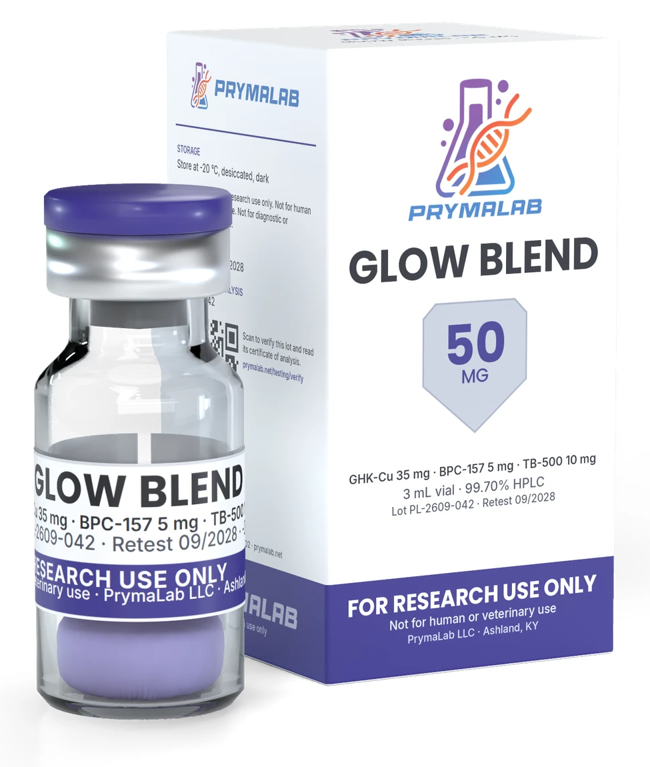
GLOW Blend 50 mg
LYOPHILIZED VIALThe smaller vial: 35 mg GHK-Cu, 5 mg BPC-157 and 10 mg TB-500.
- GHK-Cu
- 35 mg
- BPC-157
- 5 mg
- TB-500
- 10 mg
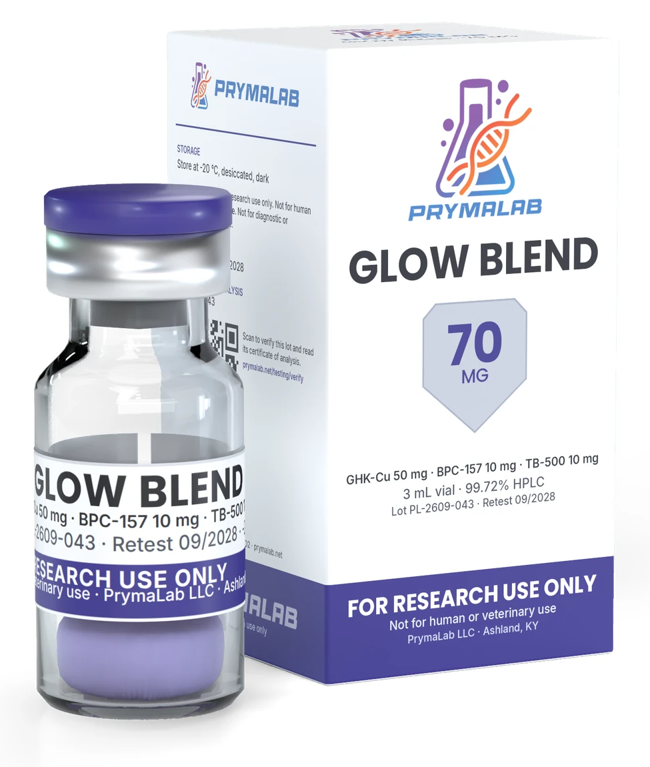
GLOW Blend 70 mg
LYOPHILIZED VIALMore GHK-Cu and BPC-157, with the same 10 mg of TB-500.
- GHK-Cu
- 50 mg
- BPC-157
- 10 mg
- TB-500
- 10 mg
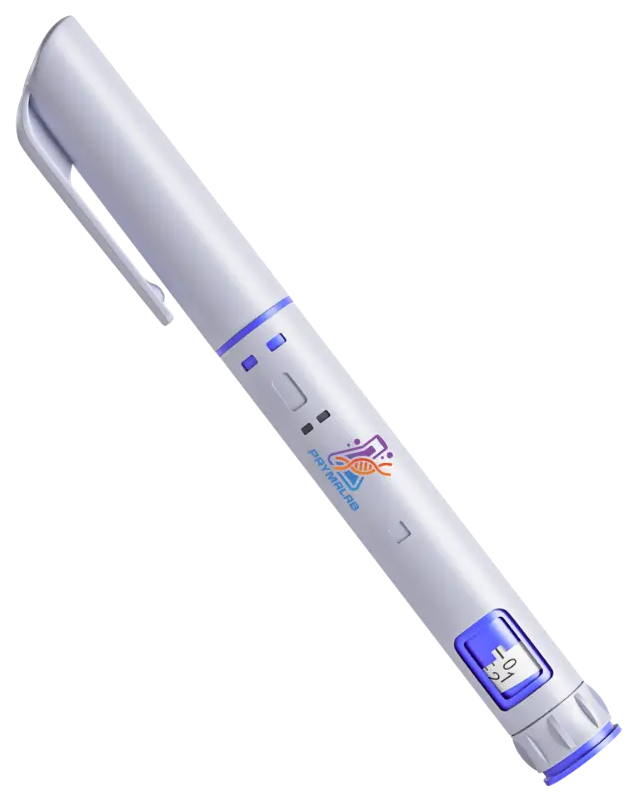
GLOW Autoinjector
PRELOADED / 3 mL DEVICEA prefilled 3 mL cartridge. The blend is already in solution.
- GHK-Cu
- 107 mg
- BPC-157
- 21.4 mg
- TB-500 (Thymosin β4)
- 21.4 mg
GLOW vs KLOW: frequently asked questions
Is KLOW just GLOW with KPV?
For the specific 70 mg and 80 mg formulas compared here, yes: the same 50/10/10 mg base plus 10 mg KPV. That shorthand does not describe every product carrying the names.2
Does GLOW 50 have the same ratio as GLOW 70?
Does KLOW contain more copper peptide?
Not in this comparison. GLOW 70 and KLOW 80 both declare 50 mg GHK-Cu. The extra labeled mass is KPV.
Is KLOW better for redness or gut symptoms?
The reviewed KPV study does not establish that outcome for this commercial blend in people. A cellular or mouse finding is not a personal treatment recommendation.
Does the GLOW pen have KPV?
No KPV is listed in the supplied GLOW pen specification. The named components are GHK-Cu, BPC-157 and TB-500.8
Can I combine GLOW and KLOW for more benefits?
That would overlap the three shared ingredients. The sources here do not establish a benefit or a safe regimen for doing so; do not treat stacking as a simple upgrade.
Where do I compare the GLOW options?
Use Buy Online for the two vials and pen, and Quality + COA for their supporting documents.
Sources used in this article
Product records, primary research and original community accounts are identified separately. Source access checked November 2, 2026; no independent product assay or clinical review is claimed.
Supplied manufacturer in-house report, lot PL-2609-043. Composition, identity and lot results.
Manufacturer-declared 50/10/10/10 mg composition. Indexed specification checked November 2, 2026; direct page retrieval timed out.
Supplied manufacturer in-house report, lot PL-2609-042. Composition, identity and lot results.
Dalmasso et al., 2008. Cell experiments and mouse colitis models, not a trial of KLOW.
Maquart et al., 1988. Primary cell-culture study; PMID 3169264.
Chang et al., 2011. Primary tendon-tissue/cell experiment; PMID 21030672.
Malinda et al., 1999. Primary animal wound-model study; PMID 10469335.
Manufacturer specification supplied by the publisher, referencing PL-SDS-070; not an independent batch assay.