On this page
What benefits do people report from GLOW?
Skin appearance is the clearest theme in the accounts reviewed: smoother texture, a brighter-looking complexion and a firmer appearance. People also discuss stronger nails, hair changes and less everyday discomfort. These are reports about personal experience, not a guarantee that every user will notice the same changes.
Skin appearance
Texture, brightness and a firmer look are recurring themes in personal accounts.
Hair and nails
Accounts discuss hair feel, growth and stronger nails, often with other products in the routine.
Recovery interest
The shared ingredients are studied in repair-related models; this is distinct from proving a human recovery benefit.
In one public thread, silvercupz described brighter, smoother skin and stronger nails after three weeks; AdhesivenessMore3925 described slightly firmer-looking abdominal skin and younger-looking hands at six weeks. Both are subjective observations rather than measured changes in collagen or elasticity.1
That makes it useful to separate three questions: what someone noticed, how long they had been using the product, and whether anything else changed. This article starts with the outcomes people care about, then explains the ingredient research behind the interest.
Community examples are selected public accounts, not reviews collected from our customers or a representative success rate. They concern different products and routines. Reaction reports are included below.
Skin texture, brightness and fine-line appearance
A report of a better complexion can mean several different things: skin feels smoother, dark spots appear less obvious, or the face looks brighter in photographs. A softer-looking line is an appearance observation; it is not automatically evidence of new collagen.
What is behind the collagen connection?
GHK-Cu is the copper-peptide part of GLOW. In a laboratory study, it stimulated collagen synthesis in cultured fibroblasts. That is a specific finding about cells, and it explains the scientific interest in the ingredient. The experiment did not test the finished three-component GLOW blend in people.2
Route also matters. A small randomized study of GHK-Cu skin products after CO2 laser resurfacing found greater satisfaction, but no significant advantage on the objective wrinkle or overall skin-quality assessments at 12 weeks. It tested topical care after a procedure, not these injectable research products.3
The useful takeaway: cosmetic improvements appear in personal accounts, while the research questions and product formulations are more specific. A marketing phrase such as "collagen support" does not tell you the size or likelihood of a visible change.
For photographs rather than ingredient mechanisms, continue to GLOW before-and-after comparisons.
Hair growth, hair feel and stronger nails
These outcomes should not be bundled into a single promise. Smoother-feeling hair is different from new growth; a stronger nail is different from faster growth. The accounts reviewed include all of these descriptions, but they do not measure them in the same way.
Amazing-Repeat2852 described new hair and eyelash growth during a three-month course, plus some skin improvement. The same discussion includes collagen supplementation, so it does not isolate an effect from GLOW alone.4
Another poster, Mysterious_Set149, described hair regrowth after more than four months overall. That account used a 30/10/10 mg formulation and also discussed hormone optimization. Its product was not the 35/5/10 mg GLOW 50 vial listed on this website.5
What timeline should I take from these reports?
Think of them as individual follow-up points, not a schedule you can count on. The hair accounts cover several months. They do not establish that extending use causes more growth or that a particular course will reverse hair loss.
The GLOW vs KLOW article also explains why a photo or review of a four-ingredient KLOW blend should not be relabeled as evidence for GLOW.
Recovery, joints and tissue repair
GLOW includes the BPC-157 and TB-500 pairing that also appears in products marketed as Wolverine. The additional GHK-Cu ingredient changes the formulation; it does not turn findings about the individual components into a proven recovery protocol.
In the BPC-157 tendon study, researchers examined rat tendon explants and cultured cells. They observed greater cell outgrowth, migration and survival under oxidative stress. The study did not measure how quickly a human athlete returned to training.6
Thymosin beta-4 was also investigated in an animal wound model, with findings relevant to wound repair. The supplied GLOW certificates identify their TB-500 ingredient as full-length thymosin beta-4, so that identity is retained here instead of silently substituting a shorter fragment.789
Feeling less sore, recovering normal movement and showing structural healing are different outcomes. A personal report can describe comfort; it cannot by itself prove tendon repair. A new or persistent injury needs an appropriate clinical assessment rather than an assumption that a blend will resolve it.
How quickly might someone notice a change?
Reports span weeks to months, and there is no validated GLOW results calendar. The most useful distinction is between early impressions, a later comparison photograph and a measured clinical outcome.
Texture or appearance
A person may describe how their skin looks or feels. That does not establish a stable effect or its cause.
Photos over time
Photos can illustrate visible differences. They need an actual interval and should stay attached to the original case.
Defined assessment
Collagen, hair density and injury healing need their own measurements. They cannot be calculated from a selfie.
A three-month testimonial by PomegranateFormal961 describes other people commenting positively on facial appearance. The poster also used a GHK-Cu/SNAP-8 cream, hormone therapy and other compounds. It is an example of a favorable experience, not an isolated test of GLOW.10
Our results timeline puts the named accounts and their reported intervals together. Our cycle discussion deals with how long people said they used products; those are separate questions.
Does GLOW help with weight loss?
The sources used for this article do not establish GLOW as a weight-loss treatment. Someone describing looser skin while losing weight is reporting a skin concern during a separate change in body weight. That is not evidence that the blend caused fat loss.
Likewise, using more ingredients does not automatically produce more benefits. GLOW contains three named components; the KLOW formulation reviewed adds KPV. Comparing their compositions is straightforward, but claiming that one delivers faster or better cosmetic results would require a suitable comparison study.
When a review mentions several other peptides, skincare products or hormone treatments, keep those details with the result. They are part of the account, not an optional footnote to remove for a stronger-looking claim.
What side effects do people mention?
Some of the same threads that contain enthusiastic appearance reports also describe stinging, irritation, bruising and itchy red injection sites. The accounts do not establish how common those reactions are or whether a particular preparation is safe.14
Do not treat pain, redness or a lack of stinging as a test of product quality. A batch report measures specified sample properties; it is not a personal safety assessment. The products shown here are supplied for laboratory research, not human or veterinary use.89
For a personal health decision, discuss the actual product and other medicines with a licensed clinician. This article describes reports and research; it does not provide a treatment plan.
Compare the formulations, not a "results strength"
The 50 mg and 70 mg vials have different ingredient ratios. The pen is a preloaded solution with its own stated contents. A larger labeled amount or a higher chromatographic purity figure is not evidence of a better cosmetic outcome.8911
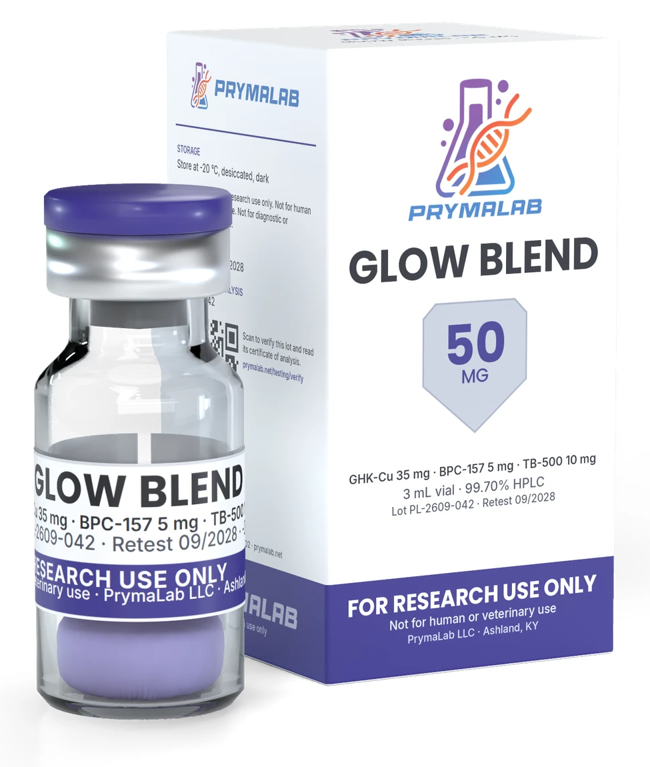
GLOW Blend 50 mg
LYOPHILIZED VIALThe smaller vial: 35 mg GHK-Cu, 5 mg BPC-157 and 10 mg TB-500.
- GHK-Cu
- 35 mg
- BPC-157
- 5 mg
- TB-500
- 10 mg
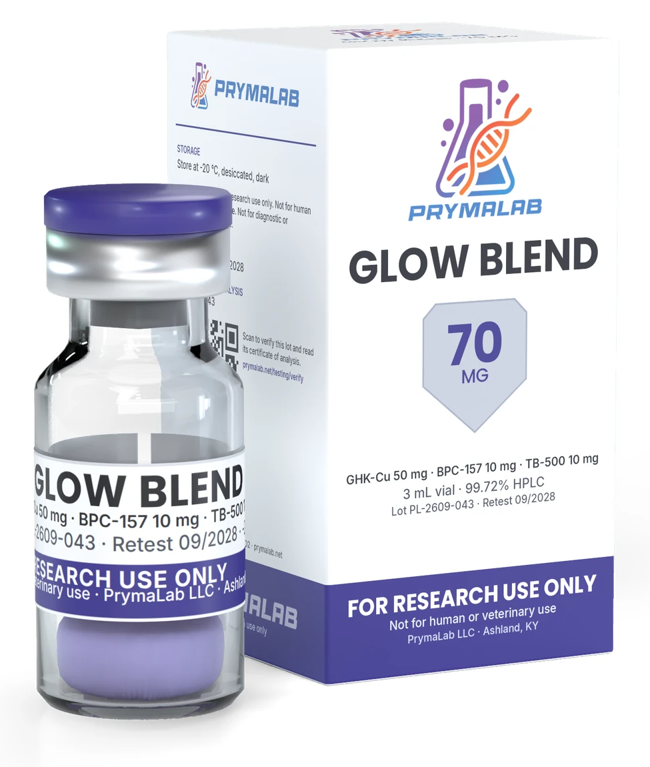
GLOW Blend 70 mg
LYOPHILIZED VIALMore GHK-Cu and BPC-157, with the same 10 mg of TB-500.
- GHK-Cu
- 50 mg
- BPC-157
- 10 mg
- TB-500
- 10 mg
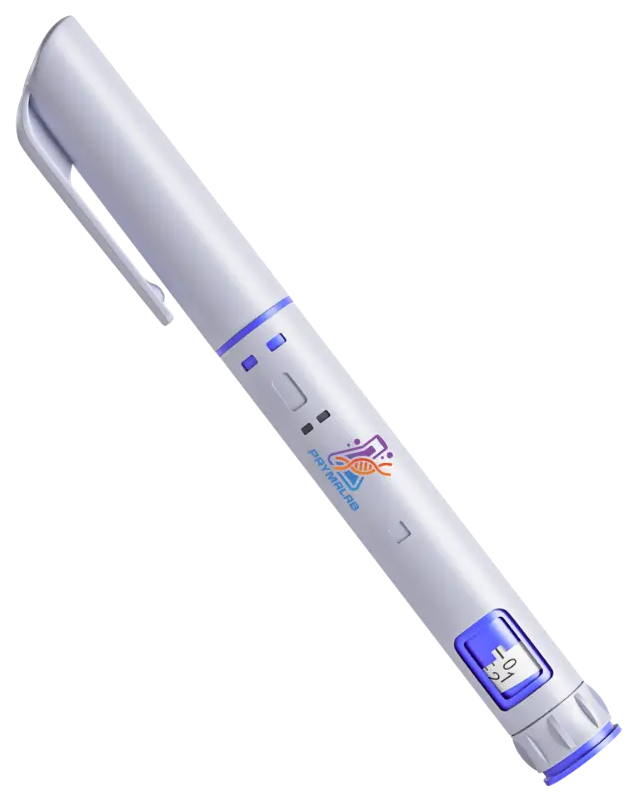
GLOW Autoinjector
PRELOADED / 3 mL DEVICEA prefilled 3 mL cartridge. The blend is already in solution.
- GHK-Cu
- 107 mg
- BPC-157
- 21.4 mg
- TB-500 (Thymosin β4)
- 21.4 mg
Open Quality + COA to see the original reports, or use Buy Online to compare the three formats. Prices and checkout are not supplied by a research paper.
GLOW benefits: common questions
Can GLOW provide cosmetic benefits?
Some public accounts describe cosmetic improvements. They are experiences, not a guaranteed effect or an estimate of how many people benefit. The relevant original posts are linked above.
Will it remove wrinkles?
The sources reviewed do not establish wrinkle removal from these finished blends. A collagen result in cell culture is not a clinical wrinkle outcome.
Is it mainly for skin or recovery?
Both topics appear in GLOW discussions. Skin and hair changes are prominent in personal reports; recovery interest also draws on component studies. Those sources answer different questions.
Does the 70 mg vial work better than 50 mg?
A different formula does not establish better outcomes. The actual quantities are 35/5/10 mg and 50/10/10 mg; choosing one cannot be based on a claimed clinical advantage absent a suitable comparison.
Does the pen contain a different ingredient list?
It contains the same three named components. Its declared contents are 107/21.4/21.4 mg in a preloaded 3 mL solution, approximately a 5:1:1 ratio.11
Where can I compare reports and photos?
See Before & After for the supplied photo comparison and Quality + COA for the original batch documents. They serve different purposes.
Sources used in this article
Product records, primary research and original community accounts are identified separately. Source access checked November 2, 2026; no independent product assay or clinical review is claimed.
Named accounts include silvercupz, AdhesivenessMore3925 and Psychomuffin22. Personal reports, including reactions; not verified customer reviews.
Maquart et al., 1988. Primary cell-culture study; PMID 3169264.
Miller et al., 2006. Randomized topical post-procedure study; PMID 16847171.
Amazing-Repeat2852 and m00nlightsunrise among other commenters. Personal experiences and concurrent products.
Mysterious_Set149. A 30/10/10 mg blend, repeated courses and hormone optimization; not our GLOW 50 formulation.
Chang et al., 2011. Primary tendon-tissue/cell experiment; PMID 21030672.
Malinda et al., 1999. Primary animal wound-model study; PMID 10469335.
Supplied manufacturer in-house report, lot PL-2609-042. Composition, identity and lot results.
Supplied manufacturer in-house report, lot PL-2609-043. Composition, identity and lot results.
PomegranateFormal961. Original report of quantities and facial observations, with concurrent topical cream, hormones and other products.
Manufacturer specification supplied by the publisher, referencing PL-SDS-070; not an independent batch assay.